Arvind Limited, having a workforce of almost 15,000 is the first ever Indian clothing company/brand that has published its sustainability report and also got recognition for the same on an international platform. This recognition is a motivation for other Indian companies that are moving forward on the sustainability route, but need to be more focused. The company has adopted the Global Reporting Initiative (GRI) G3.1 guidelines to evaluate its sustainability performance and in most of the disclosures, level of reporting is marked as ‘Fully’ while in few others it is ‘Partially’ or ‘Not’. The report addresses the economic, social and environmental performance of the company to Arvind’s stakeholders and describes its approach to sustainability, stakeholder engagement and an identification of the key sustainability issues.
A founder member of Sustainable Apparel Coalition (SAC), and having either certification or association with most sustainability monitoring agencies like GOTS, BCI, SAI, ISO, Global Reporting Initiative (GRI), Arvind has developed a method for structured identification of stakeholder groups, understanding their concerns and incorporating their views in its sustainability strategy. This method was developed as part of a Sustainability Roadmap study by E&Y. The material issues have been identified by the Sustainability Accounting Standards Board and a detailed assessment of impact of material issues on business led to the short listing of 17, among the 43 identified material issues that have the highest impact on its business.
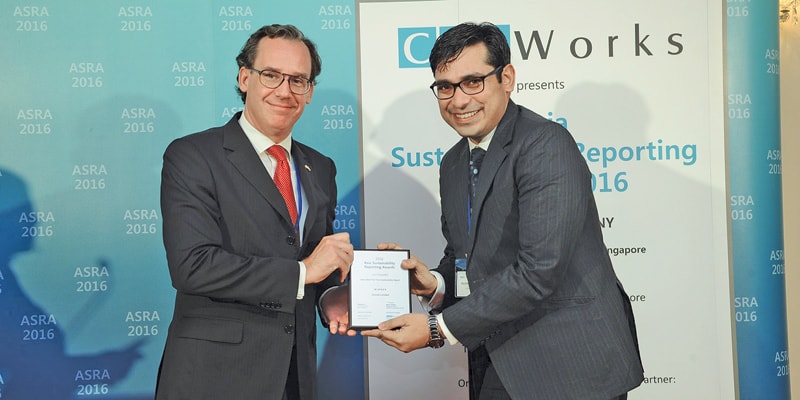
Arvind Limited clinched Asia’s Best First-Time Sustainability Report award at the recently concluded 2016 Asia Sustainability Reporting Awards (ASRA) in Singapore. Sanjay Lalbhai, Chairman, Arvind Limited said, “The award reiterates our commitment towards sustainability. Sustainable practices have been a key-focus area for Arvind for quite some time now and we continue to ensure that sustainability remains a top priority.” Arvind was also declared joint winner in the Asia’s Best Materiality Reporting category. The event was hosted by the British High Commission.
This 88-page long sustainability report for the year FY 2013-14 has identified six core inputs – Cotton, People, Money, Energy, Water and Chemicals, as propelers of business. And in all these segments, the company has put in great effort for sustainable growth. Arvind has a close relation with cotton farmers, having 80,500 acres under BCI (Better Cotton Initiative) and organic cultivation wherein more than 9,000 farmers and almost 60,000 farm workers get employment. During the FY 2013-14, the company consumed 74,638 tonnes of cotton, out of which 15 per cent (7,650 tonnes) was produced at BCI project farms while 2,550 tonnes were from organic cotton farms.
Recognizing the importance of credibility in the supply chain, Arvind claims to be maintaining 100 per cent traceability, as the company’s management information system helps to preserve the chain of custody right from seed to shop floor. It buys the crop directly from the farmer at fair market prices prevailing at the time of purchase. A ‘Farm Gate’ payment policy ensures that payments are made to farmers within seven working days through account payee bank cheques. The company has established sustainable contract farming relationships with scores of farmers, and it measures and manages performance in accordance with the Higg Index. These efforts resulted into 29 per cent more yield for better cotton farmers and 27 per cent less water consumption.
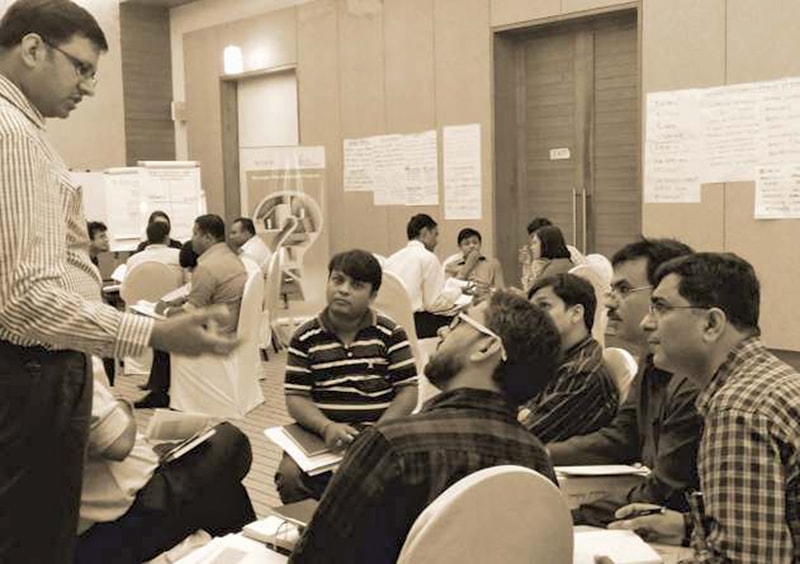
How important training is at Arvind can be understood by the fact that 3,105 man-days of employee training was done in FY 2013-14. There were 1,971 participants and 53 training programmes were organized. In outbound training, 450 participants actively partook in around eight such trainings. ‘Unnati’ is the worker development programme where the workers go through six months of rigorous training in Phase 1 and have to work on a six-month project in Phase 2. Upon completion, the workers get an opportunity to be promoted as supervisors. Another initiative – ‘Udaan’ (a 6-month programme) is for junior management development. The company claims that no incidents of gender, human rights or any other form of discrimination have been reported during the review period.

Efforts around energy include savings in natural gas consumption through use of energy-efficient stenters; 680 KW was saved by switching to high capacity air compressors, while 20 per cent less fuel consumption was possible by using humidity sensor in tumble dryer. It has zero liquid discharge system at Santej unit and 100 per cent recycled water usage at its Bangalore unit. Arvind managed to reel-in the absolute water consumption at Santej unit by 20.8 per cent by using comprehensive water management initiatives, while Naroda unit showed a growth of approximately 7 per cent. Of its total water requirement, 41.4 per cent is met by recycling and reusing the wastewater in-house.
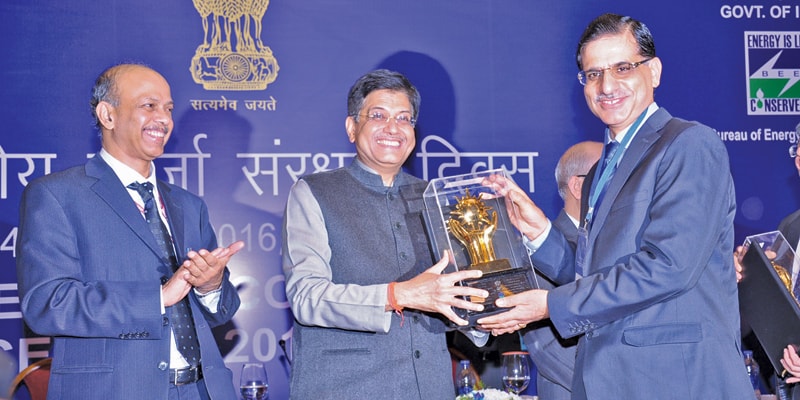
The company also bagged the Top Rank Award in Energy Conservation and Efficiency at National Energy Conservation Awards 2016, organized by The Bureau of Energy Efficiency (BEE), Ministry of Power in New Delhi. Susheel Kaul, CEO – Lifestyle Fabrics (Shirting, Khaki & Knitwear), Arvind Limited said, “At Arvind, improving our plant’s energy efficiency has always been a focus, and we continue to invest in new technologies for sustained energy conservation.”
Post the review period, Arvind has further improved its sustainability performance and in FY 2014-15 the company treated 19.5 million m3 wastewater under its water management scheme. Arvind Limited was also able to further reduce specific consumption in thermal energy by nearly 12 per cent, besides achieving 12 per cent reduction in specific electrical energy consumption at its Santej plant in Ahmedabad, in FY ’15-16. It has also installed 1.30 MW roof-top solar power generation at the plant. As far as chemical usage is concerned, chemicals hazard tracking sheet created for entire chemical supply chain, Arvind Denim Lab is accredited by NABL, Levi’s & GAP etc. for physical & chemical testing. Salt-recovery by MVRE (mechanical vapour re-compressor) and chillers for re-use in dyeing is another step of the company.
Its community initiatives are conceived and efficiently executed by the Strategic Help Alliance for Relief to Distressed Areas (SHARDA) trust, which is the CSR implementation arm of the company. It ensures that a family has five basic needs, according to their priority – Clean potable water at their doorsteps, including individual toilets and hygienic surroundings; Prevention of major diseases and treatment of basic ailments; Access to high-quality secondary and tertiary healthcare; Basic skill-oriented education programmes on reading, writing & arithmetic skills; and Vocational skills and abilities to compete in a highly competitive environment. About 1,300 students are getting benefited every year from Gyanda Programme, including the Sanjay Nagar (Ahmedabad) slum development project in the list of ‘100 best practices’ by UNCHS. The company is also closely associated with 300 individuals trained for skill upgradation in collaboration with NIFT.
Sustainability pours in the product portfolio of the company, be it Neo Denim (which is a sustainable dyeing concept where there is no drainage of dye, before or after the process for shade adjustment), Authentic Denim (hand spun, hand hank dyed in natural indigo and woven on the handloom), Advanced Denim (manufactured using a ground breaking technology that reduces water and energy consumption by up to 92 per cent and 30 per cent, respectively compared to traditional indigo dyeing method), natural indigo denim fabrics, excel denim, linen denim, scafe denim and recycled poly with different peculiarities. It is important to note that during the reporting period, the company’s denims business grew 18 per cent in volume to 105 million metres – (highest ever in the last decade) and woven fabrics business achieved 19 per cent growth in volume to 103 million metres, (highest ever volume).




 Bharat Tex Special Report 2026