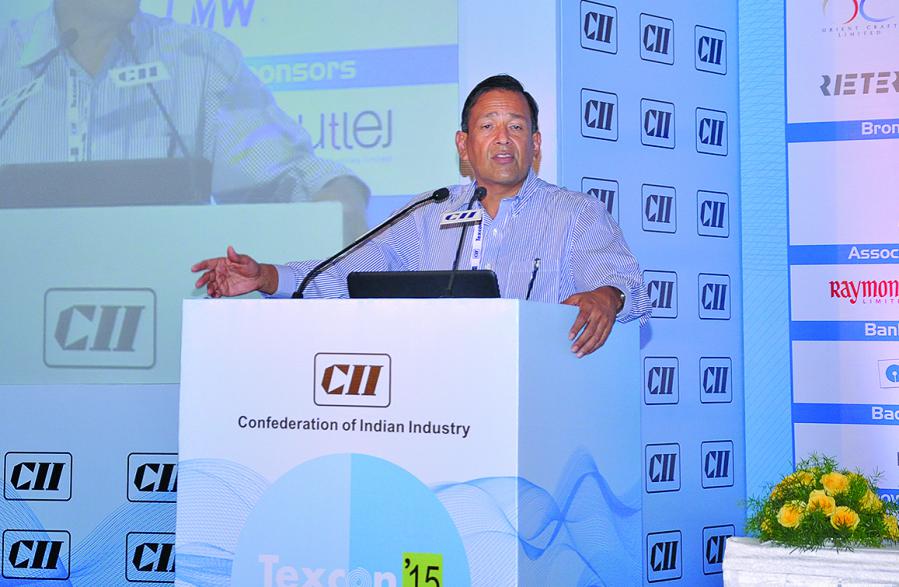
Sachit Jain, Vice Chairman, CII National Committee on Textiles and Executive Director, Vardhman Textiles Ltd., has said that the TransPacific Partnership (TPP) will adversely impact the Indian textiles industry because of the yarn forward provision which requires the yarn and fabric used in final product to be manufactured in one of the free trade partners to qualify for duty-free treatment under the trade pact. At present, India exports yarn and fabric to Vietnam which then exports the finished products to countries like the US. Now, with the yarn forward provision in the TPP, they will have to either source it from some other free partner country or produce domestically, hurting India’s exports adversely. He was addressing the Texcon ’15, International Conference and Exhibition on Textile and Apparel organized by CII.
“India should take all possible steps to join the APEC (AsiaPacific Economic Cooperation) forum, which accounts for nearly 60% of global GDP. This would provide a pathway for greater integration into the region’s economy,” he added. The TPP is a trade agreement that will open markets, and enable countries like Vietnam a zero-duty access to the US market for textiles, while Indian players will have to pay 14-32% duties, which will make them uncompetitive.
A report on ‘How to Enable Make in India Possible in Textile and Apparel Sector’ was also released by CII and Wazir Advisors on this occasion. The report has strongly called for huge thrust required on the part of the Government to aggressively enter into as many FTAs as possible with select textile markets in Asia and European Union to safeguard the Indian textile and apparel industry and set off the negative impact of the recently negotiated TPP between USA and 11 other Asia-Pacific countries (Australia, Brunei Darussalam, Canada, Chile, Japan, Malaysia, Mexico, New Zealand, Peru, Singapore, and Vietnam). Sunil Porwal, Additional Chief Secretary (Textile) – Co-operative, Marketing and Textiles Department, Maharashtra shared that the state has planned to open eight more textile and apparel mega parks in cotton belts.